The Beginner's Guide to Investing in Sealed Pokémon TCG Products (UK Edition)
A complete UK beginner's guide to sealed Pokémon TCG investment — booster boxes, ETBs, key metrics like box % and momentum, and how to avoid overpaying for hype.
Track these live, free →
Product and price sources vary by article. Stored reports describe their stated observation periods; check dated tool references before comparing current listings. Sources and methodology. For informational purposes only.
Stored article: amounts and product status reflect the observation periods described here. Publication and editorial update dates are not necessarily price observation dates. Check the dated tool references before comparing current listings.
Last updated: 2026-09-01
Sealed Pokémon TCG product — booster boxes, Elite Trainer Boxes (ETBs), and special collections — has quietly become one of the more interesting alternative asset classes of the last few years. Some sets have multiplied in value within months of release; others have sat flat or dropped once the hype faded. The difference between the two almost never comes down to luck. It comes down to data.
This guide walks through what sealed product investing actually involves, the metrics that matter, and how to avoid the single biggest beginner mistake: buying based on vibes instead of numbers.
What "Sealed Product Investing" Actually Means
When people say they "invest in Pokémon," they're usually doing one of three things:
- Buying booster boxes and holding them sealed, betting the box appreciates faster than inflation (or a savings account)
- Buying Elite Trainer Boxes for a specific promo card, exclusive art, or set-specific desirability
- Buying singles (individual cards) — a different game entirely, closer to trading cards than sealed collecting
This guide focuses on sealed product — boxes and ETBs — because it's the segment where UK collectors have the clearest data edge and the lowest barrier to entry.
Why the UK Market Is Different
Pokémon TCG pricing is usually quoted in USD, but UK collectors buy and sell in GBP, through UK retailers and UK eBay listings. That currency and market gap creates real pricing inefficiencies — a set can look "cheap" on a USD price tracker while actually trading at a premium once you account for FX, shipping, and UK-specific demand (or the reverse). Tools that track GBP pricing specifically — rather than converting USD figures after the fact — give a much more accurate picture of what you'd actually pay or receive in the UK market.
The Metrics That Actually Matter
Most beginners judge a box by "does the price look high or low." That's not a strategy — it's a guess. Here are the metrics that separate an informed buy from a gamble:
Box Percentage (Box %)
This is the single most useful number in sealed investing. It compares the current booster box price to the total value of the singles inside the box. A lower box % means the box is cheap relative to what's inside it — you're effectively paying less than the box's contents are worth on the secondary market. A higher box % means you're paying a premium purely for the sealed/collectible factor.
Real examples from current tracked data:
| Set | Era | Box % | TCGInvest Signal |
|---|---|---|---|
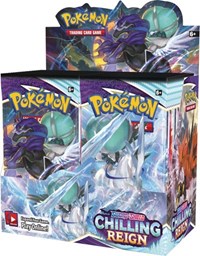
| Chilling Reign | SWSH | 24.3% | Strong Buy |
| S&V 151 | S&V | 100.0% | Accumulate |
| 30th Celebration | MEGA | 216.0% | Overvalued |
| Phantom Forces | XY | 688.8% | Overvalued |
A box sitting at 688.8% box % means the sealed box now costs almost 7x the value of the cards inside it — buyers are paying almost entirely for scarcity and nostalgia, not underlying card value. That's not necessarily a bad hold long-term, but it's a fundamentally different bet than buying a box at 24% of its singles value.
Momentum (7-day / 30-day)
Price direction matters as much as price level. A box trending up over 30 days behaves very differently to one that spiked and is now cooling off, even if today's price is identical. Momentum data catches sets before a trend is obvious from the headline price alone.
Heat Score
A composite score blending price momentum, chase card trend, and pull rate data into a single 0–100 figure. It's a fast way to see which sets are attracting real market attention right now versus which have gone quiet.
Booster Boxes vs. ETBs: A Quick Note
Booster boxes and Elite Trainer Boxes behave differently as investments — ETBs carry a specific promo card plus accessories, so their premium is driven by that promo's desirability rather than pure singles value. We cover this comparison in full detail in a separate guide if you're deciding between the two.
Risk Factors Beginners Miss
- Reprints. A set that gets reprinted (common with popular sets) can see its box % spike downward overnight as supply increases.
- Presale vs. in-print status. Presale boxes carry additional uncertainty — the eventual print run size isn't fully known yet.
- Condition and box damage. A "sealed" box with a crushed corner or shelf-wear can trade meaningfully below a mint box, particularly for higher-value sets.
- Concentration risk. Putting your entire budget into one set (however hyped) is the same mistake as any other undiversified investment.
See live box % and momentum data for every tracked set →
How to Start (Without Overspending)
- Start with the free tracker tools. The Booster Box Tracker and ETB Tracker are free to browse — no account needed to see current pricing.
- Watch a handful of sets before buying anything. Add sets to a watchlist and observe how box % and momentum move over a few weeks before committing money.
- Set a price alert. Rather than checking prices manually, a price alert notifies you when a set crosses a threshold you actually care about.
- Only then, buy. Once you understand a set's box % trend and its risk profile, you're buying with information — not hype.
FAQ
Is investing in sealed Pokémon product actually profitable in the UK? It can be, but it's asset-specific — some sets have significantly outperformed savings rates and even some traditional investments, while others have underperformed. The metrics above (box %, momentum, heat score) are what separate the two outcomes; blind buying is a coin flip.
Do I need to grade cards to make money from Pokémon TCG? No — sealed product investing (this guide) and card grading are two separate strategies. If you're specifically interested in grading ROI, see our PSA grading guide.
How much money do I need to start? Some ETBs are available from around £55 MSRP, and current-print booster boxes range widely. You don't need a large budget to start learning the metrics — the free tools let you track and learn before you spend anything.
Data sourced from TCGInvest's daily pipeline across 110+ tracked sets and 33 ETBs. Explore all tools →
Track these prices live
Free tools with dated observations — no account required for basic data