PSA Grading for Pokémon Cards: Is It Worth It? A Full ROI Breakdown
Is PSA grading worth it for Pokémon cards in 2026? A full ROI breakdown using real raw vs PSA 10 price data, grading fees, and pull rate economics.
Track these live, free →
Product and price sources vary by article. Stored reports describe their stated observation periods; check dated tool references before comparing current listings. Sources and methodology. For informational purposes only.
Stored article: amounts and product status reflect the observation periods described here. Publication and editorial update dates are not necessarily price observation dates. Check the dated tool references before comparing current listings.
Last updated: 2026-09-01
Every Pokémon collector eventually asks the same question: should I send this card off for PSA grading, or leave it raw? The honest answer is "it depends entirely on the card" — but most people never actually run the numbers before deciding. This guide breaks down exactly how to calculate grading ROI, using real price data rather than guesswork.
What PSA Grading Actually Changes
PSA grading authenticates a card and assigns it a condition grade from 1 to 10. A PSA 10 ("Gem Mint") commands a significant premium over the same card raw — sometimes 2x, sometimes over 50x — because graded cards are considered lower-risk purchases for buyers, and a PSA 10 is a verified top-condition copy.
The premium is never uniform. It depends on the card's rarity, print quality consistency for that specific set, and current market demand. That's why blanket advice like "always grade your chase cards" is unreliable — the economics vary wildly card to card.
The Grading ROI Formula
To evaluate whether a specific card is worth grading, you need four numbers:
- Raw price — what the ungraded card sells for today
- PSA 10 price — what a confirmed Gem Mint copy sells for today
- Grading fee — PSA's cost to grade the card (varies by service tier)
- Grade multiplier — PSA 10 price ÷ raw price
If (PSA 10 price − raw price − grading fee) > 0, grading is profitable assuming the raw card you send in actually comes back a 10 — which is the part most guides skip entirely.
Real Example
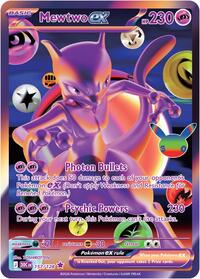
One of the highest-multiplier chase cards currently tracked is a Mewtwo ex from 30th Celebration (Futuristic Rare, card #157):
| Metric | Value |
|---|---|
| Raw price | £36.18 |
| PSA 10 price | £2,220.35 |
| Grade multiplier | 61.4x |
| Estimated grading ROI | +£2,164.17 (3,852%) |
| TCGInvest grade signal | Worth It |
That kind of multiplier is rare — most cards sit far closer to 1.5x–4x. But it illustrates why checking the actual numbers per card matters far more than following general "grade everything" advice. A 61x multiplier card and a 1.5x multiplier card require completely different decisions, even if they look similarly desirable on the shelf.
The Number Nobody Talks About: Grade Probability
The formula above assumes your raw copy grades a 10. In reality, most raw copies — even ones that look mint to the naked eye — don't. Centering, surface scratches invisible without magnification, and corner wear from factory packing all knock copies down to a 9 or lower, where the price premium is dramatically smaller (often barely covering the grading fee).
This is the single biggest reason grading disappoints people: they calculate ROI based on the PSA 10 price, then receive a PSA 8 or 9 back. Before submitting a card, look specifically for:
- Centering — closest to 50/50 front, 60/40 back or better
- Corners — sharp, no whitening, no soft/rounded edges
- Surface — no scratches, indentations, or print lines under raking light
- Edges — clean, no chipping
If a card doesn't clearly meet PSA 9–10 standards under close inspection, the ROI math almost never works out, regardless of how attractive the raw-to-PSA-10 spread looks on paper.
Grading Fees and Turnaround
Grading fees vary by PSA service tier and change periodically — always check PSA's current published fee schedule before submitting, since it directly changes your breakeven point. Turnaround time is also a real cost: your capital (and the card) is tied up for weeks to months depending on tier, during which the market price can move against you either way.
Browse grading ROI signals across 1,600+ tracked chase cards →
When Grading Usually Doesn't Make Sense
- Low-value commons and uncommons — the fee alone can exceed the card's entire raw value
- Cards with heavy print-run variance — sets known for inconsistent centering are riskier to grade blind
- Already-low grade multipliers (under ~2x) — after fees, shipping, and grading risk, the margin often isn't worth tying up capital
- Cards you plan to sell quickly — turnaround time can mean missing the market window entirely
When Grading Usually Does Make Sense
- High grade-multiplier chase cards in strong demand (like the example above)
- Cards you're already confident meet near-perfect centering and surface standards
- Cards from sets with consistently strong PSA population data, reducing uncertainty about the grade outcome
FAQ
What's a "good" grading multiplier? There's no universal number, but many experienced graders treat anything under roughly 2x–3x as marginal once fees, shipping, and grade-probability risk are factored in. Cards like the 61x example above are the exception, not the rule.
Does PSA 10 always mean the highest price? Not necessarily — for some ultra-rare or vintage cards, PSA 9 copies can still command strong prices, and the gap to PSA 10 can be extreme due to genuine grading rarity at the top. Check the specific card's grade multiplier rather than assuming.
Can I check grading ROI before buying a card, not just before submitting one I own? Yes — this is exactly how experienced buyers use grading data: sourcing raw cards specifically because their current grade multiplier suggests strong post-grading upside.
Grading ROI figures calculated from TCGInvest's daily PriceCharting-sourced raw and PSA 10 data across 1,600+ chase cards. See live grading signals →
Track these prices live
Free tools with dated observations — no account required for basic data